
The Hebrew and Greek that is translated as “goat” in English is translated in Cherokee as ahwi dinihanulvhi or “bearded deer.” (source: Bender / Belt 2025, p. 18)
Bamboo

Painting by Soichi Watanabe, used with permission by the Overseas Ministries Study Center (OMSC) at Princeton Theological Seminary. You can purchase this and many other artworks by artists in residence at the OSMC in high resolution and without a watermark via the OSMC website .
“A resident of Koshigaya City, Saitama, Japan, Soichi Watanabe was the 2008-09 OMSC artist in residence. Watanabe graduated in 1982 from the Ochanomizu Art School in Tokyo after having earned, a decade earlier, an economics degree from Tohoku Gakuin University in Sendai. He teaches at a private art school that he started in 1982. Following his 1982 graduation, Soichi founded a private art school where he and his wife work together to help others experience the joy of art.
“Soichi was drawn to God as an undergraduate student during a home Bible study when he encountered Mark 8:35: ‘Whoever wants to save his life will lose it, but whoever loses his life for me and for the gospel will save it.’ Further study of the New Testament led him to realize that he was both ‘stubborn and self-centered.’ He recalls that ‘the richness of the biblical world overwhelmed me and at the same time tortured me.’
“Shortly thereafter he chose to submit his life to God at an evening worship service. ‘I really heard a voice telling me to accept the salvation of Jesus on the cross and to follow him,’ remembers Soichi. From that point on he has been determined to serve God through his abilities. As a follower of Jesus, Soichi points to his faith as the foundation from which he works as an artist. In his art book Jesus Walking With Us (2004), he writes, ‘I realize that [my works] are my own humble responses to God’s calling in my life… . The images are often given to me through the words of God at worship services on Sundays and during my daily devotion. I have the earnest hope that I will go on painting to praise the Lord.'” (Source )
About this image, Watanabe says: “In his book When the Bamboo Bends, Dr. Masao Takenaka wrote about the relationship between Christianity and bamboo. The connection with bamboo is that it symbolizes unselfishness. It has an empty core, but it is flexible and strong, like faith. A fresh wind can blow through a grove of bamboo like the Holy Spirit. In November of 2008 I went to an exhibition of bamboo artwork by contemporary Japanese artists at the Japan Society, which is in front of the United Nations building in New York City. Former president of the Japan Society Richard Wood was a friend of Dr. Takenaka, and also supported the artist in residence program at OMSC. It was in America that I felt the beauty of bamboo and remembered Masao and his ‘bamboo theology.’” (Source: OMSC 2010, p. 34)
Like Trees Planted by Streams of Water
Painting by Soichi Watanabe, used with permission by the Overseas Ministries Study Center (OMSC) at Princeton Theological Seminary. You can purchase this and many other artworks by artists in residence at the OSMC in high resolution and without a watermark via the OSMC website .
“A resident of Koshigaya City, Saitama, Japan, Soichi Watanabe was the 2008-09 OMSC artist in residence. Watanabe graduated in 1982 from the Ochanomizu Art School in Tokyo after having earned, a decade earlier, an economics degree from Tohoku Gakuin University in Sendai. He teaches at a private art school that he started in 1982. Following his 1982 graduation, Soichi founded a private art school where he and his wife work together to help others experience the joy of art.
“Soichi was drawn to God as an undergraduate student during a home Bible study when he encountered Mark 8:35: ‘Whoever wants to save his life will lose it, but whoever loses his life for me and for the gospel will save it.’ Further study of the New Testament led him to realize that he was both ‘stubborn and self-centered.’ He recalls that ‘the richness of the biblical world overwhelmed me and at the same time tortured me.’
“Shortly thereafter he chose to submit his life to God at an evening worship service. ‘I really heard a voice telling me to accept the salvation of Jesus on the cross and to follow him,’ remembers Soichi. From that point on he has been determined to serve God through his abilities. As a follower of Jesus, Soichi points to his faith as the foundation from which he works as an artist. In his art book Jesus Walking With Us (2004), he writes, ‘I realize that [my works] are my own humble responses to God’s calling in my life… . The images are often given to me through the words of God at worship services on Sundays and during my daily devotion. I have the earnest hope that I will go on painting to praise the Lord.'” (Source )
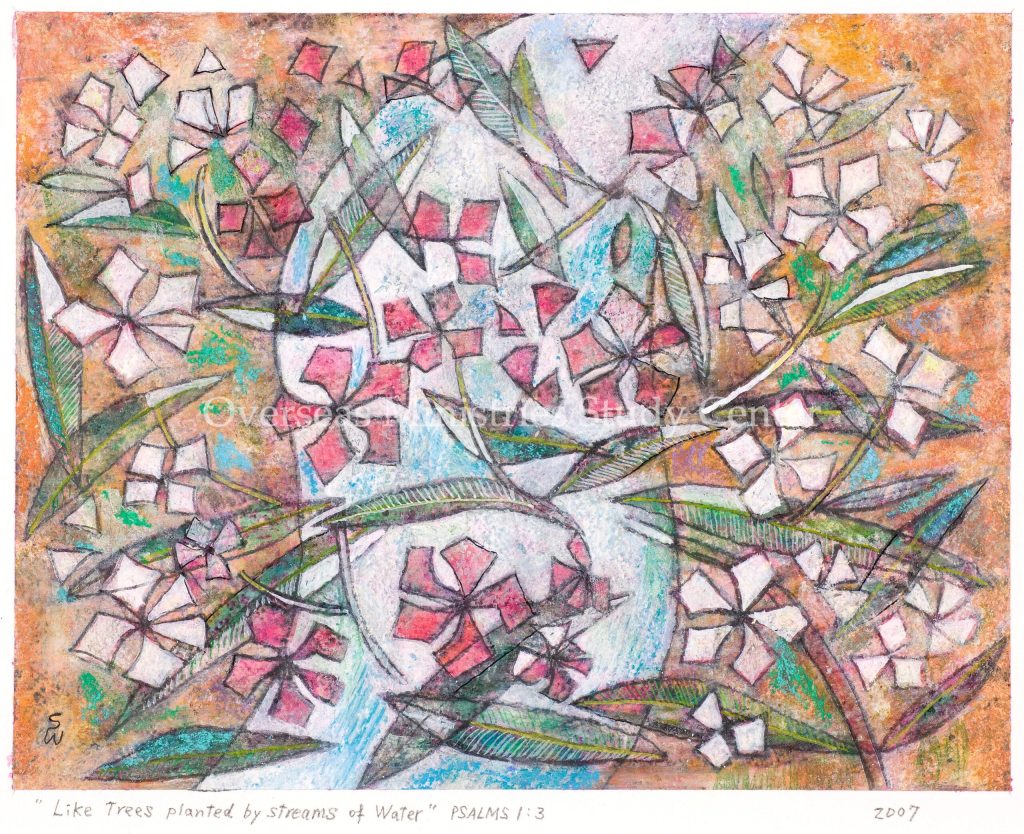
About this image, Watanabe says: “The plant this title refers to is an oleander. According to Plants of the Bible, by H. N. and A. L. Moldenke, ‘the cedar that is planted by streams of water’ (Sirach 39:13) is this plant. I am also remembering Psalm 1 here, because I have often sung that psalm.” (Source: OMSC 2010, p. 34)
Lotus - the Grace of God
Painting by Soichi Watanabe, used with permission by the Overseas Ministries Study Center (OMSC) at Princeton Theological Seminary. You can purchase this and many other artworks by artists in residence at the OSMC in high resolution and without a watermark via the OSMC website .
“A resident of Koshigaya City, Saitama, Japan, Soichi Watanabe was the 2008-09 OMSC artist in residence. Watanabe graduated in 1982 from the Ochanomizu Art School in Tokyo after having earned, a decade earlier, an economics degree from Tohoku Gakuin University in Sendai. He teaches at a private art school that he started in 1982. Following his 1982 graduation, Soichi founded a private art school where he and his wife work together to help others experience the joy of art.
“Soichi was drawn to God as an undergraduate student during a home Bible study when he encountered Mark 8:35: ‘Whoever wants to save his life will lose it, but whoever loses his life for me and for the gospel will save it.’ Further study of the New Testament led him to realize that he was both ‘stubborn and self-centered.’ He recalls that ‘the richness of the biblical world overwhelmed me and at the same time tortured me.’
“Shortly thereafter he chose to submit his life to God at an evening worship service. ‘I really heard a voice telling me to accept the salvation of Jesus on the cross and to follow him,’ remembers Soichi. From that point on he has been determined to serve God through his abilities. As a follower of Jesus, Soichi points to his faith as the foundation from which he works as an artist. In his art book Jesus Walking With Us (2004), he writes, ‘I realize that [my works] are my own humble responses to God’s calling in my life… . The images are often given to me through the words of God at worship services on Sundays and during my daily devotion. I have the earnest hope that I will go on painting to praise the Lord.'” (Source )
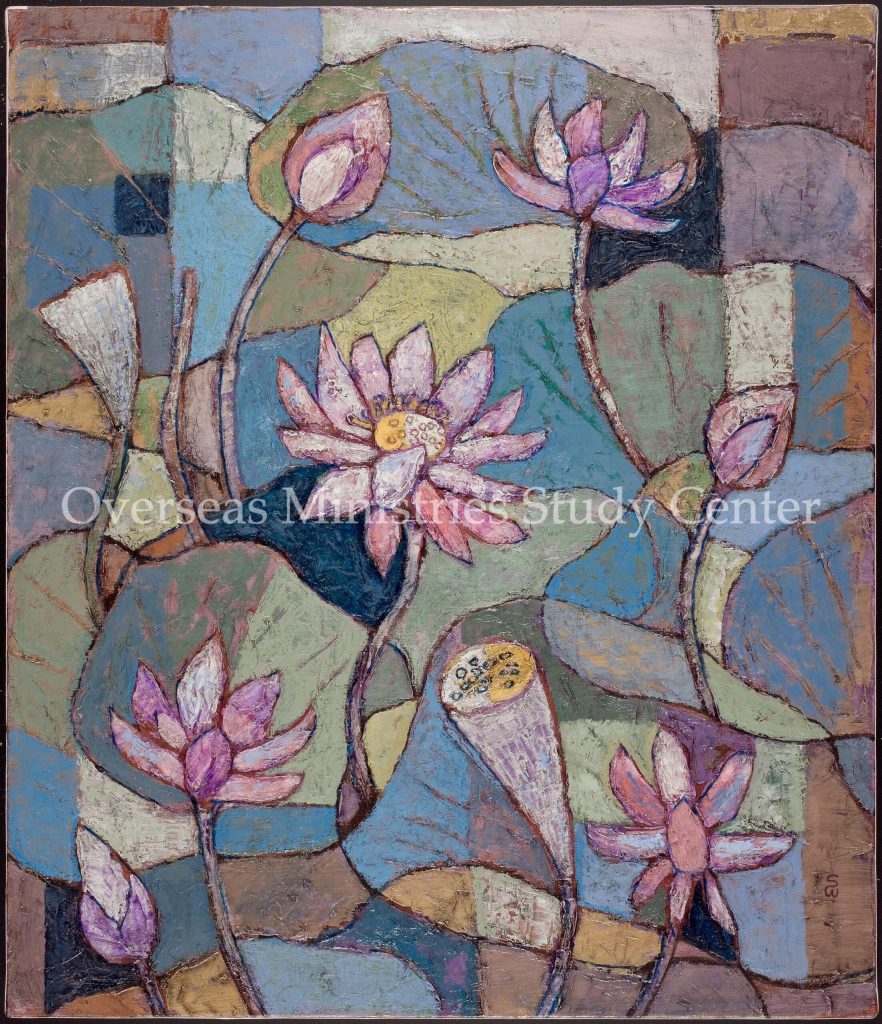
About this image, Watanabe says: “Lotus icons are usually found in Buddhist temples. However, when I was making a sketch of a lotus flower in a pond, I became convinced that the flower was the ‘saint flower,’ because light shines out from the center of this flower. According to some books that have pictures of plants that are found in the Bible, the sculptures of lilies in Solomon’s temple were of water lilies [see Song of Songs 2:1], as the wild lotus plant can be found growing in Israel. I came to understand the deep biblical connection that exists with the lotus or the water lily.” (Source: OSMC 2010, p. 90)
be like a gazelle or a young stag
In Gbaya, the notion of the exuberant joy of the gazelle and young stag (which in the Gbaya translation are replaced with the local oribi and a young bushbuck ) is emphasized with zaŋgule, an ideophone used to describe something very joyful.
Ideophones are a class of sound symbolic words expressing human sensation that are used as literary devices in many African languages. Since the subject matter of Songs of Songs is particularly conducive to the use of ideophones, there are a total of 30 ideophones in the Gbaya Bible in that short biblical book alone. (Source: Philip Noss)
See also fawns / gazelle and fawns / gazelle.
eyes are like doves / bathed in milk
In Gbaya, the notion of clearness of the “eyes (that) are like doves” in Song of Songs 5:12 is emphasized with ŋgɛ́lɛ́lɛ́, an ideophone used to describe something very clear and pure. Note that the “doves” are substituted with “herons that land over the water.”
The notion of the white color (“like milk”) is emphasized with kàlàkùlɛ̀ɛ̀, an ideophone used to to specifically describe something that is white as milk.
Ideophones are a class of sound symbolic words expressing human sensation that are used as literary devices in many African languages. Since the subject matter of Songs of Songs is particularly conducive to the use of ideophones, there are a total of 30 ideophones in the Gbaya Bible in that short biblical book alone. (Source: Philip Noss)
See also eyes are doves / flock of goats and snow (color).
worm / maggot
In English, “worm” is a fairly general word, while “grub” refers to worms and insect larvae that eat fruit and some vegetables such as beans. “Maggot” refers to the worm-like larvae flies and beetles, which feed on decaying meat or flesh. The Hebrew words tole‘ah and tola‘ath are fairly general terms for worms of all kinds, regardless of what the worms eat.
In Exodus, Leviticus, and Numbers there occurs the phrase tola‘ath shani, literally “worm of scarlet”. The Hebrew name indicates both a scarlet color and the dye producing this color. The dye is made from the kermes insect Coccus ilicis, which was found in the Ararat region. The dye was traded by the Phoenicians, who carried it to the Middle East, North Africa, southern Europe, Mesopotamia, and even further.
Unlike the more general words tole‘ah and tola‘ath, rimah and its Greek equivalent skōlēx refer exclusively in the Bible to flesh-eating worms, in other words, maggots. The use of “worm” and “vermin” in modern English versions is motivated by the fact that to say that one’s own body is covered with maggots is repulsive and impolite in English culture. It may not be in other cultures.
Worms, grubs, and maggots are small, soft, legless, tube-shaped creatures that have no bones or shells. They typically feed on overripe fruit, rotting meat, and similar things. Most are actually larvae that hatch from the eggs laid by flies or some beetles. Most of them mature into pupae and then into adult forms of the parent insects.
In the Bible worms and maggots are symbols of uncleanness, decay and insignificance. In Psalms 22:6 and Isaiah 41:14 the word tola‘ath signifies a very insignificant human being or even nation. Where comparing a person with a worm or maggot will not convey the same meaning, it may be possible to find some other insect which symbolizes insignificance. Where no such comparison exists, it will be necessary to follow something like “weak and helpless as a worm.”
Maggots were a symbol of uncleanness, decay, and death. In Job 25:6 the maggot is symbolic of a repulsive, insignificant person.
Worms and maggots are found universally, and finding equivalents should not be too hard. However, in many languages there are specific words for different kinds of worms or maggots, but no generic word that includes them all. In such cases the individual contexts should guide the translator. When the reference is to worms destroying grapes or olives, a suitable word for such a context should be found; when the reference is to maggots that feed on corpses, a suitable word for these contexts should be used. It is more important to translate appropriately for a given context than it is to translate one Hebrew or Greek word the same way every time.
The use of a word for a flesh-eating worm or maggot is appropriate for all contexts.
Source: All Creatures Great and Small: Living things in the Bible (UBS Helps for Translators)
spider
The two occurrences of this word in the Hebrew Bible are both in phrases that refer to the spider’s web. There is unanimity on this interpretation.
Spiders are eight-legged creatures that typically produce silken strands of web. This material may be used for making net-like webs (in the case of the orb spiders), lining nests, covering eggs, or, in the case of the trap-door spider, for making a hinge for the trap door. The orb spiders, which seem to be the ones referred to in the Bible, spin webs in which they catch their prey, mainly flying insects, such as flies, grasshoppers, and the like. In Israel there are literally scores of different spider species, and ‘akavish cannot be associated with any one of them. It is a general word for all spiders.
In the Bible, the spider’s web is viewed as something weak, temporary, and easily broken.
Spiders are found everywhere throughout the world. However, the spider’s web may not be viewed as something temporary and easily broken in the receptor culture. This is what leads New English Bible to translate Isaiah 59:5 as “they weave cobwebs” rather than “they weave the spider’s web,” since the former at least conveys the idea of something undesirable and of no value. In many languages an expression, such as “they weave a weak spider’s web” is a better equivalent. In Job 8:14 there is a Hebrew word whose meaning is unknown, but the sense is fairly clear:
What he trusts is fragile;
What he relies on is a weak spider’s web.
Source: All Creatures Great and Small: Living things in the Bible (UBS Helps for Translators)